
Types of battery recommended for home solar system
If you are planning to build your own home solar power system, at some point in time, you will ask…
What are the best batteries for an off-grid solar system?
Because of the falling prices of Photovoltaic panels, charge controller, power inverter etc, more and more people are looking to use alternative energy sources as a way to:
- Save money
- Become more energy independent
- And break their dependence on the big energy companies
However, installing a residential solar energy system, in most cases, requires you to make a considerable initial investment that you won’t see the return for several years.
One of the biggest expenses associated with a home solar energy systems is the batteries in the battery bank.
Therefore, choosing the correct batteries for your home solar system is crucial (and keeping the batteries alive as long as possible is also critically important)!
You don’t have to buy new and expensive batteries
Before we tell you what 3 batteries we recommend for your home solar energy system’s battery bank…
It’s important to first note that you don’t have to buy the 3 batteries we recommend brand new.
Instead, you can use the EZ Battery Reconditioning program to:
- Get old or used batteries for free or dirt cheap
- Recondition them back to “good service” condition
- Then use those reconditioned batteries for your home solar system rather than buying new overpriced batteries
Doing this will save you a considerable amount of money when building a battery bank. This approach also enable home owners with a small budget to have access to a DIY solar system.
But that still leaves the questions…
What are the best batteries to use in your solar power energy system?
The 3 best batteries for a DIY solar power bank
The following are 3 types of battery we’ll recommend for you:
1.Electric Golf Cart Batteries

Electric golf cart batteries are the most widely manufactured batteries on this list.
They also work great in a residential solar system. So it’s no surprise that they’re one of the most commonly used batteries in battery banks for renewable energy systems.
Even though the five to six year life span of golf cart batteries may seem relatively short, golf cart batteries more than make up for their deficiency in this area by being very durable and cheap.
In addition, golf cart batteries can also be found almost anywhere, making them a great choice for battery banks.
If you really want to build a high quality but inexpensive battery bank, one of the best options is to:
Get old or “dead” batteries from golf courses or golf cart service shops for free …or dirt cheap.
All you have to do is call them and ask if you can have their old batteries probably lying around and cluttering their workspace.
Then recondition those batteries to like-new condition. When the batteries are in good working condition, you can then use them for your home battery bank.
2. Industrial or Forklift batteries
A battery bank that uses one or more industrial batteries follows the opposite philosophy of a golf cart battery bank.
Instead of relying on multiple strings of smaller batteries, you use a few or even one battery to store all of your home energy.
Because these batteries aren’t usually manufactured to standard dimensions, you will have to have one made that is just right for your needs.
Or you can try to find an old industrial or forklift battery that’s the correct size for your system and use that.
Like golf cart batteries, there are sometimes ways to get free or cheap forklift batteries. All you have to do is search on the internet and make some calls.
Talk to the people at industrial companies and see if they have old or “dead” forklift batteries. Offer to dispose of it for them or pay them a little bit.
If they agree, you can then recondition the battery and use it instead buying a new pricey industrial battery.
3. L16 Batteries

If you want batteries that have a little more capacity than golf cart batteries but don’t want to spend on industrial batteries, L16 batteries are a good middle ground.
These flooded lead-acid batteries were originally designed for supermarket floor scrubbers.
The good thing with these batteries is that they last a bit longer than golf cart batteries – about six to eight years.
However, they are often twice as heavy and the 6-volt models can be twice as expensive.
The Conclusion
Remember, different homes will have different power requirement and will need battery banks that are sized accordingly.
If you build a battery bank using any of the three batteries mentioned above, you should be able to create a battery bank that is just right for your home solar system.
As per our recommendation above, our three favorite batteries for residential off-grid, solar energy systems are golf cart batteries, industrial batteries and L16 batteries.
Deep Cycle Battery Reconditioning Guide
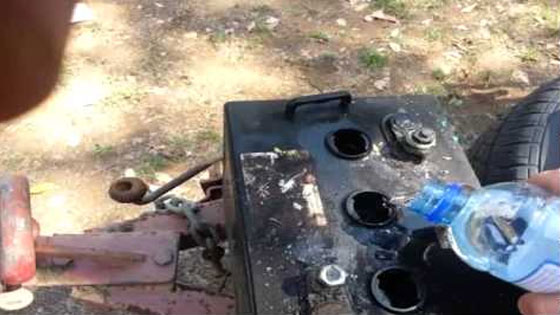
Do you want to know more on reviving dead or weak deep cycle batteries?
If you do, check out the EZ Battery Reconditioning program.
In the program, you will learn how to:
- Get old or “dead” golf cart batteries, industrial or L16 batteries
- Recondition them back to 100% of their working condition
- Use those “like-new” batteries instead of buying new overpriced batteries to save a lot of money
The guide will also show you how to recondition many other types of old, dead batteries back to 100% of their working condition again (so they’re just like new), including:
- Car batteries
- Laptop batteries
- Cell Phone batteries
- Marine batteries
- PLUS MANY MORE!
So if you’re ready to learn how to recondition all types of batteries…
…back to 100% of their working condition
…Then click the link below